What Is LVP Floor Lifting & Separation?
LVP (Luxury Vinyl Plank) is one of the most widely installed flooring products in Southern California. Its combination of water resistance, durability, and appearance make it the dominant choice for residential renovations — but it also generates a significant share of the flooring inspection requests we receive.
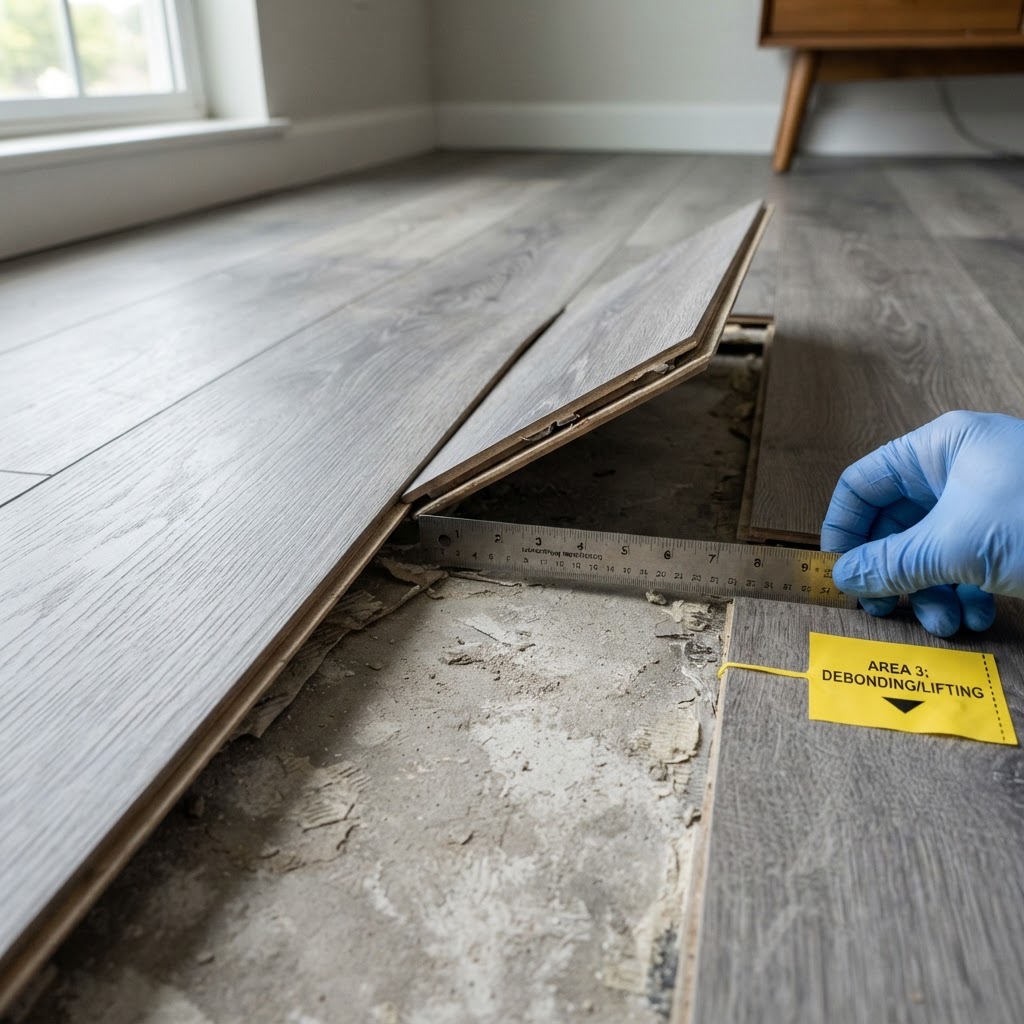
LVP lifting is distinct from joint separation. Lifting refers to planks that have actually risen off the subfloor — either as individual planks or as sections of the floor. The planks are no longer in contact with the substrate and may flex dramatically underfoot.
The most common cause in Southern California is thermal expansion without adequate perimeter expansion gaps. West and south-facing rooms with significant sun exposure can see floor surface temperatures far above air temperature — and a floating LVP floor with no room to expand has only one option: it lifts.
What Causes LVP Floor Lifting & Separation?
Thermal Expansion Without Perimeter Relief
All floating LVP requires expansion gaps at every fixed perimeter — walls, door frames, cabinetry, islands, posts, and transitions. In warm California climates, sun-heated floors can expand significantly. Without gaps, the floor buckles upward. This is an installation defect — not a product defect — and is the most frequently documented cause of LVP lifting in our inspection practice.
Subfloor Moisture Affecting Underlayment
LVP itself is waterproof, but the wood-composite underlayment used beneath many LVP products can absorb moisture, swell, and cause the LVP above to lift. Concrete slab moisture vapor can also disrupt the foam pad underlayment, reducing contact and support — causing sections to feel hollow and eventually lift.
Subfloor High Spots and Improper Preparation
LVP installed over subfloor high spots rocks across the high point. Over time, foot traffic concentrates stress on the locking joints at the high point, causing them to fail and the planks to lift. Manufacturer specifications typically require subfloor flatness within 3/16" in 10 feet — a standard that is frequently not verified before installation.
Adhesive Failure in Glue-Down Systems
Glue-down LVP installations require an adhesive appropriate for the product and substrate. Adhesive failure from moisture, wrong product selection, or improper application causes lifting in glue-down systems. This failure type requires investigation of both the adhesive and the substrate moisture condition.
Symptoms to Look For
- Planks that rock or flex when walked on
- Audible popping or snapping as floor moves
- Visible gaps between plank edges and wall or baseboard
- Sections of floor that have visibly lifted off the subfloor
- Locking joints that have failed and cannot be pressed back together
- Hollow sounds when walking across lifted sections
What an Inspector Checks
When to Call an Inspector
Call a certified inspector when:
• LVP is lifting in a newly installed floor
• Multiple rooms or large areas are affected
• The installer or builder disputes the cause
• An insurance claim is involved
• You need documentation for a manufacturer warranty claim
Our Inspection Process
Frequently Asked Questions
Is LVP lifting always the installer's fault?
Most LVP lifting failures trace to inadequate expansion gaps — an installation defect. However, if the subfloor was inadequately prepared (contractor defect), if the product had a documented manufacturing defect, or if a moisture event caused adhesive failure, the responsibility may involve other parties. Inspection establishes the cause before responsibility is assigned.
Can lifted LVP planks be re-locked without replacement?
If the locking mechanism is undamaged and the cause is corrected (expansion gap created, subfloor leveled), some lifted planks can be re-engaged. If the lock tabs are broken, cracked, or deformed, those planks require replacement. In widespread lifting, full removal and reinstallation with correct installation practices is typically required.
Related Flooring Issues
SPC / Rigid Core
SPC (Stone Plastic Composite) and rigid core flooring develops separating or open joints when thermal expansion forces exceed the locking mechanism's capacity — typically caused by inadequate expansion gaps or extreme heat exposure.
Learn moreVinyl / LVP
Vinyl floor buckling — where planks or sheets lift dramatically off the subfloor — is caused by thermal expansion without adequate room, moisture beneath the floor, or adhesive failure in glue-down systems.
Learn moreMoisture Diagnostics
Adhesive failure in glue-down flooring — vinyl, LVP, hardwood, or tile — causes debonding, hollow sounds, and buckling. The cause is almost always substrate moisture, wrong adhesive selection, or improper application.
Learn more