
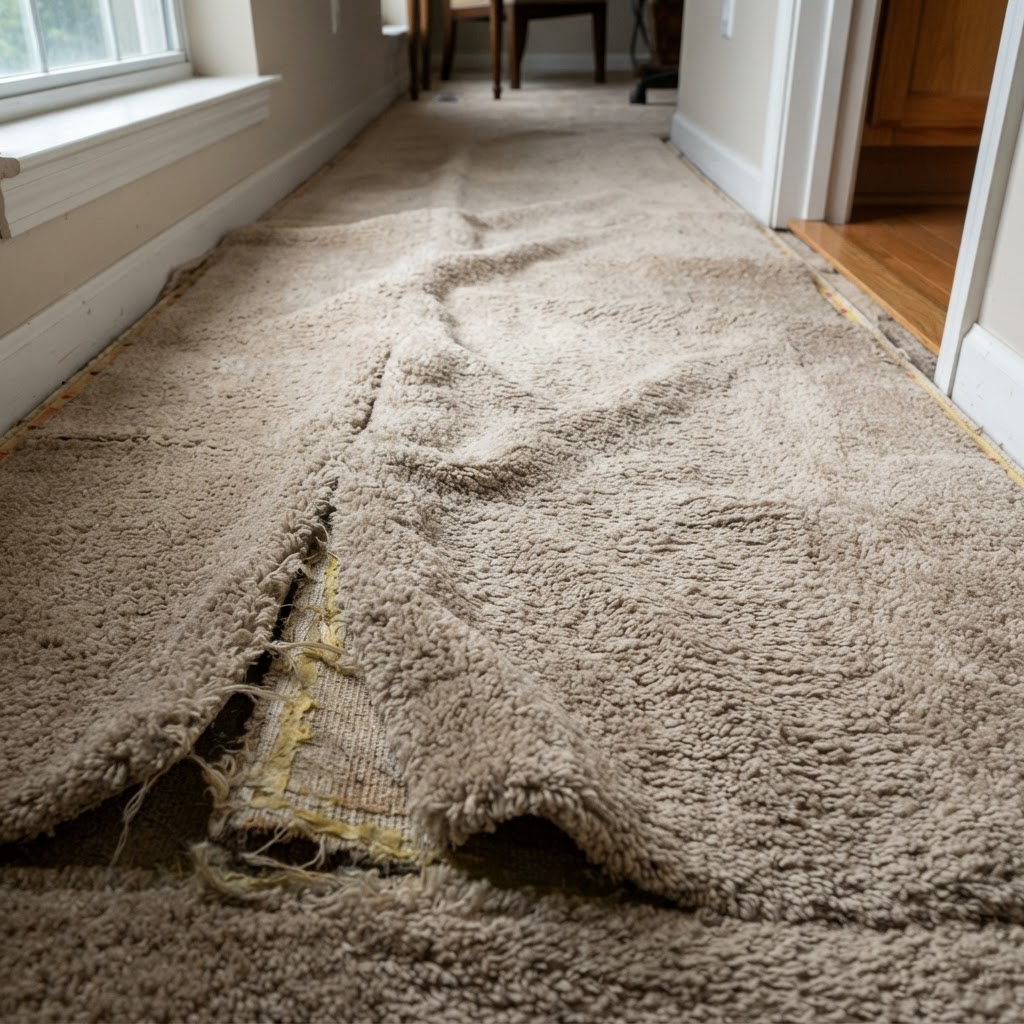
What Is Carpet Buckling & Wrinkling?
Carpet buckling — also called wrinkling, rippling, or delamination — is one of the most common carpet failures in both residential and commercial installations. The condition appears as raised ripples, waves, or wrinkles across the carpet surface that flex underfoot and create a tripping hazard.
In stretch-in installations, carpet is held taut over tack strip by the tension of the backing material. When that tension is lost — through backing delamination, improper stretching at installation, or environmental conditions — the carpet relaxes and forms wrinkles. In glue-down installations, adhesive failure causes similar bubbling and lifting.
The secondary backing on most residential carpet is a polypropylene scrim bonded to the primary backing with a latex adhesive. When this latex adhesive degrades — from moisture, age, manufacturing deficiency, or improper installation — the secondary backing separates from the primary, and the carpet loses its dimensional stability entirely.
Root Cause Analysis
Why Carpet Floors Fail
Carpet failures are fundamentally different from hard-surface flooring failures. Carpet is a flexible, fabric-backed system that relies on tension (in stretch-in installations) or adhesive bond (in glue-down installations) to remain flat and stable. When that tension or bond is lost — through improper installation, backing degradation, or environmental conditions — the carpet wrinkles, buckles, or separates from the substrate.
Failure to Power-Stretch
CRI (Carpet and Rug Institute) installation standards require power stretching with a knee stretcher AND a power stretcher. When installers use only a knee kicker — or skip stretching entirely — the carpet is installed under insufficient tension and wrinkles within weeks or months. This is the single most common carpet installation defect.
Secondary Backing Delamination
The latex adhesive bonding the secondary backing to the primary backing can fail from manufacturing deficiency, moisture exposure, age, or chemical degradation. Once delamination occurs, the carpet loses structural integrity entirely — re-stretching cannot hold, and replacement is the only option.
Moisture and Humidity Cycling
Carpet backings absorb moisture from high indoor humidity, water events, or wet subfloors. The backing softens and stretches when wet, then settles into permanent wrinkles when it dries. Properties with inconsistent HVAC operation are especially vulnerable.
Adhesive Failure in Glue-Down Installations
Glue-down carpet depends entirely on adhesive bond. Wrong adhesive selection, insufficient coverage, subfloor moisture, or contaminated substrates cause sections to lift, bubble, and separate from the subfloor — failures that mirror adhesive failures in other glue-down flooring systems.
Incompatible Cushion or Padding
Manufacturer warranties specify cushion type, density, and thickness. Using a cushion that is too soft, too thick, or not approved by the carpet manufacturer causes excessive flex under foot traffic, which stretches the backing and creates wrinkles over time.
What Causes Carpet Buckling & Wrinkling?
Improper Stretching at Installation
Carpet must be power-stretched using a knee stretcher and power stretcher per CRI (Carpet and Rug Institute) installation guidelines. When installers use only a knee kicker — or skip power stretching entirely — the carpet is installed under insufficient tension and develops wrinkles within weeks or months.
Secondary Backing Delamination
The latex adhesive bonding the secondary backing to the primary backing can fail from manufacturing deficiency, moisture exposure, age, or chemical degradation. When delamination occurs, the carpet loses its structural integrity and wrinkles form across the field.
Moisture and Humidity
Carpet backings absorb moisture. High indoor humidity, water events, or installation over wet subfloors causes the backing to soften and stretch. When the moisture dissipates, the relaxed carpet settles into wrinkles. Latex-backed carpets are particularly vulnerable.
Temperature Cycling
Significant temperature fluctuations cause carpet backings to expand and contract. Over time, this cycling relaxes the carpet tension, particularly in homes where HVAC is turned off during extended absences — a common scenario in Southern California vacation and investment properties.
Adhesive Failure in Glue-Down Installations
Glue-down carpet depends entirely on adhesive bond. Wrong adhesive selection, insufficient adhesive coverage, subfloor moisture, or contaminated substrates cause sections to lift, bubble, and separate from the subfloor.
Heavy Furniture and Rolling Loads
Heavy furniture placed on carpet without proper glides, or rolling office chairs on carpet without chair mats, stretches and distorts the backing. Over time, this creates localized wrinkles and permanent distortion.
Symptoms to Look For
- Visible ripples, waves, or wrinkles across the carpet surface
- Carpet flexes or moves underfoot when walked across
- Wrinkles that worsen with humidity or after cleaning
- Carpet pulling away from tack strip at room edges
- Bubbling or lifting in glue-down installations
- Visible separation between primary and secondary backing at edges
- Wrinkles recurring after the carpet has been re-stretched
What an Inspector Checks
When to Call an Inspector
Contact a certified flooring inspector when:
• Carpet wrinkles appear within 1–2 years of installation
• Wrinkles recur after re-stretching
• The installer or manufacturer disputes the cause
• Delamination is visible at carpet edges or seams
• An insurance claim involves water-damaged carpet
• You need documentation for a warranty claim or dispute
Our Inspection Process
Frequently Asked Questions
Can buckled carpet be fixed without replacement?
If the backing is intact and the carpet is in good condition, re-stretching with a power stretcher can remove wrinkles. However, if the secondary backing has delaminated, the carpet has lost its structural integrity and re-stretching will not hold — replacement is required.
Is carpet buckling the installer's fault?
Most buckling in new installations is caused by improper stretching — specifically, failure to use a power stretcher as required by CRI guidelines. However, delamination from manufacturing defects, moisture events, or age-related adhesive degradation involve other parties. Inspection establishes the root cause.
Will humidity cause my carpet to buckle?
High humidity alone rarely causes buckling in a properly installed carpet. However, humidity combined with marginal installation — insufficient stretch, weakened backing, or aging adhesive — can trigger wrinkling. Properties with inconsistent HVAC operation are most at risk.
How long does carpet installation warranty cover buckling?
Most installer warranties cover buckling for 1–2 years, as this is the period in which installation-related tension loss becomes apparent. Manufacturer warranties cover backing delamination and product defects for longer periods, typically 5–25 years depending on the product.
Related Flooring Issues
Moisture Diagnostics
Moisture beneath flooring — from concrete vapor emission, plumbing leaks, or groundwater — is the single most common cause of flooring failures. Professional ASTM-certified moisture testing establishes the source, magnitude, and impact.
Learn moreMoisture Diagnostics
Adhesive failure in glue-down flooring — vinyl, LVP, hardwood, or tile — causes debonding, hollow sounds, and buckling. The cause is almost always substrate moisture, wrong adhesive selection, or improper application.
Learn more