
What Is Engineered Wood Flooring Failure?
Engineered wood flooring is composed of a real wood veneer bonded to multiple cross-ply layers — typically HDF (High Density Fiberboard) or hardwood plywood. This construction is designed to deliver the appearance of solid hardwood with improved dimensional stability across varying moisture conditions.
Despite this stability advantage, engineered wood flooring is not immune to failure. In Southern California, engineered wood failures are among the most frequently inspected flooring conditions — particularly in coastal properties, newer construction, and properties where moisture has not been properly managed. The cross-ply construction offers improved resistance to moisture movement but does not eliminate it, and delamination failures are directly tied to moisture exceeding the wood's equilibrium capacity.
What Causes Engineered Wood Flooring Failure?
Delamination from Moisture
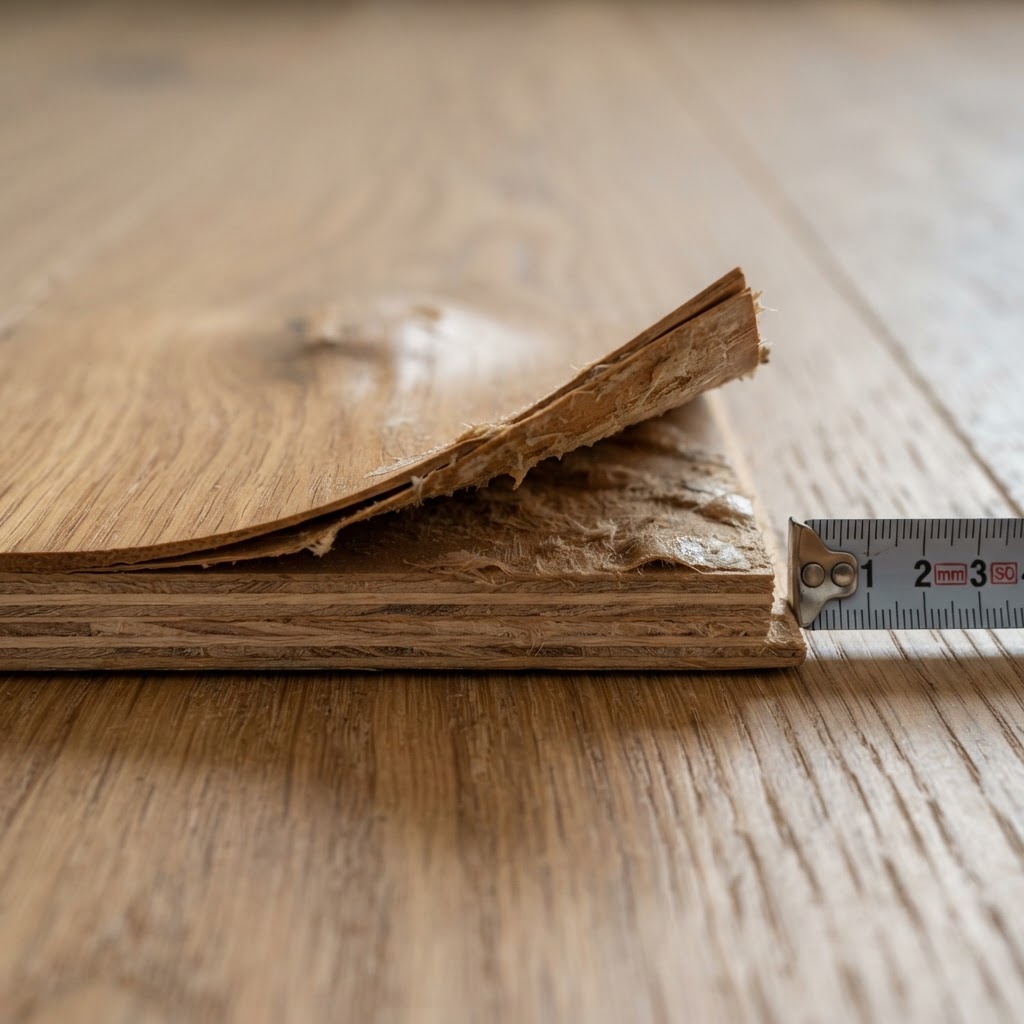
When moisture penetrates the engineered flooring assembly — from below via slab vapor, from above via spills, or laterally via plumbing leaks — the adhesive bond between layers can fail. The veneer separates from the core, appearing as bubbles, raised areas, or crumbling edge conditions. Delamination is typically irreversible and requires replacement.
Inadequate Moisture Testing Before Installation
Most engineered wood manufacturer warranties require ASTM F2170 slab moisture testing prior to installation. When contractors skip this step and install over slabs with elevated relative humidity, failure is predictable. Documentation of this omission is a common finding in forensic engineered wood inspections.
Glue-Down Bond Failure
Glue-down engineered wood systems require an adhesive appropriate for the product, correctly applied to a properly prepared substrate. Wrong adhesive selection, insufficient trowel notch size, or application over dusty, sealed, or improperly cured substrates causes widespread adhesive bond failure — the floor moves, sounds hollow, and eventually separates.
Thin Veneer Wear-Through
Lower-grade engineered products use veneers as thin as 1–2mm. In high-traffic areas, the veneer can wear through the finish layers and into the wood itself within a few years of installation. This is a product performance issue, not always an installation defect, but typically excluded from warranty coverage.
Thermal Cycling in Floating Installations
Floating engineered wood systems require perimeter expansion gaps like any floating floor. In California's warm climate, inadequate expansion gaps cause compressive loading that buckles the floor or forces joints open. Some engineered products have tighter expansion tolerances than SPC — making this failure pattern particularly important to inspect.
Symptoms to Look For
- Bubbling or raised sections in the veneer surface
- Crumbling or splintering edges at joints
- Hollow sounds when tapping the floor surface
- Visible separation between veneer and core at board edges
- Cupping or crowning across the board width
- Buckling or tenting in floating installations
- Finish wear-through exposing raw wood in traffic paths
What an Inspector Checks
When to Call an Inspector
A certified inspection is essential when:
• Delamination is occurring in a floor less than 5 years old
• The manufacturer, installer, or contractor disputes the cause
• An insurance claim involves engineered wood damage
• You are preparing a warranty claim
• Legal proceedings involve the flooring condition
Our Inspection Process
Frequently Asked Questions
Is engineered wood more moisture-resistant than solid hardwood?
Engineered wood is more dimensionally stable than solid hardwood, meaning it moves less in response to moisture changes. However, it is not waterproof. The HDF or plywood core will degrade when exposed to sustained moisture, and the veneer can delaminate from the core when moisture differentials are severe. The advantage is reduced movement, not moisture immunity.
Can delaminated engineered wood be repaired?
Individual delaminated boards can sometimes be replaced if matching material is available and the moisture source has been corrected. Widespread delamination requires full removal and replacement — and moisture mitigation before reinstallation. Attempting to re-bond lifted veneers in place rarely produces durable results.
Why does my engineered wood floor sound hollow?
Hollow sounds in engineered wood indicate either failed adhesive bond (in glue-down systems), incomplete adhesive coverage at installation, delamination of the veneer from the core, or loss of contact with the subfloor in floating systems. Systematic tap testing during inspection maps the full extent of the condition.
Related Flooring Issues
Hardwood Flooring
Cupping occurs when the edges of hardwood planks rise higher than the center, creating a concave wave across the floor surface. It is almost always a moisture-driven failure.
Learn moreVinyl / LVP
Vinyl floor buckling — where planks or sheets lift dramatically off the subfloor — is caused by thermal expansion without adequate room, moisture beneath the floor, or adhesive failure in glue-down systems.
Learn moreMoisture Diagnostics
Moisture beneath flooring — from concrete vapor emission, plumbing leaks, or groundwater — is the single most common cause of flooring failures. Professional ASTM-certified moisture testing establishes the source, magnitude, and impact.
Learn more