
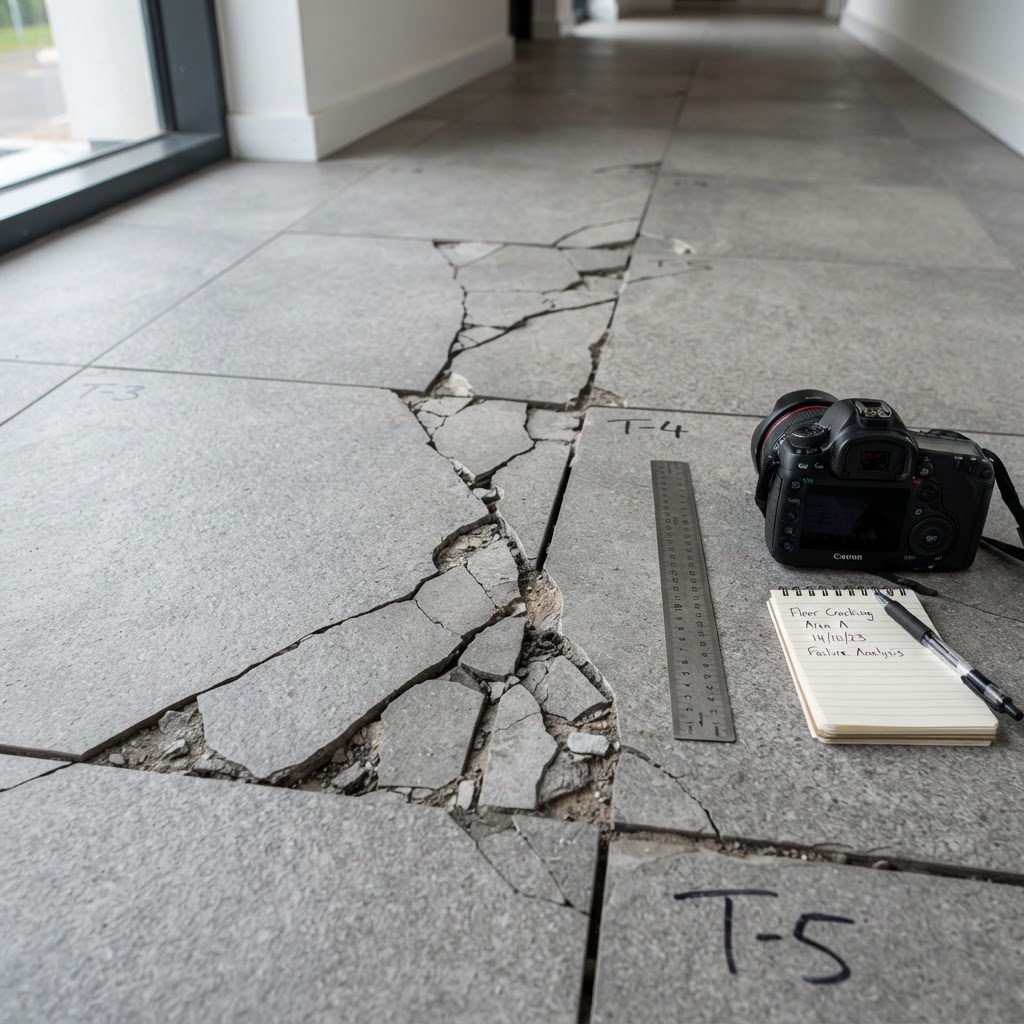
What Is Tile Floor Cracking?
Ceramic and porcelain tile is hard, brittle, and has essentially no tensile strength. When the substrate beneath tile moves — from structural deflection, concrete cracking, thermal cycling, or bond failure — the tile cannot flex. Instead, it cracks.
Tile cracking is frequently misunderstood as a product defect. In the vast majority of forensic tile inspections, the cracking is caused by substrate conditions or installation deficiencies — not tile quality. TCNA (Tile Council of North America) and ANSI A108 standards establish clear requirements for substrate flatness, deflection limits, thinset coverage, and movement joint placement. Violations of these standards are the most common precursors to tile cracking.
Root Cause Analysis
Why Tile Floors Fail
Ceramic and porcelain tile are brittle materials with virtually no tensile strength. They cannot flex, stretch, or absorb movement — when the substrate beneath them moves, the tile cracks. Tile failures are almost never product defects; they are installation and substrate failures driven by movement, moisture, or insufficient bonding that violates TCNA and ANSI standards.
Excessive Subfloor Deflection
TCNA requires tile substrates to meet L/360 deflection criteria. Wood-framed floors that flex under live load transmit movement to the tile assembly. Over time, this movement first cracks grout joints, then cracks the tiles themselves — a progressive failure that worsens with foot traffic.
Inadequate Thinset Coverage
ANSI A108.5 requires 80% mortar coverage for interior dry areas and 95% for wet areas, exteriors, and large-format tile. When installers fail to back-butter large tiles or use incorrect trowel technique, unsupported voids remain beneath tiles. Point loads over these voids crack the tile from below.
Missing Movement Joints
TCNA EJ171 requires soft movement joints at all perimeters, changes of plane, columns, and every 20–25 feet in large fields. When grout is used instead of flexible sealant at these locations, thermal expansion stress concentrates and cracks adjacent tiles.
Concrete Slab Crack Transmission
Cracks in concrete slabs — from settlement, shrinkage, or seismic activity — mirror directly through thinset to the tile above. Without a crack isolation membrane between slab and tile, any slab crack becomes a tile crack.
Moisture-Induced Debonding
Water intrusion beneath tiles degrades the thinset bond over time. Wet areas, exterior installations, and slabs with high moisture vapor emission progressively lose adhesive bond, leading to hollow tiles, cracking, and eventual debonding.
What Causes Tile Floor Cracking?
Excessive Subfloor Deflection
The TCNA Handbook specifies that tile substrates must not deflect more than L/360 under live load (L being the span length). Wood-framed floor systems that are not stiff enough allow the subfloor to flex when walked on, transmitting movement to the tile and grout. Over time, this causes cracks — first in grout joints, then in tiles themselves.
Concrete Slab Cracking
Cracks in concrete slabs — from settlement, shrinkage, thermal movement, or seismic activity — transmit directly through thinset to the tile above. Without a crack isolation membrane between the slab and the tile, these cracks mirror through the tile installation.
Insufficient Thinset Coverage
ANSI A108.5 requires a minimum of 80% mortar contact coverage for interior dry residential tile and 95% for wet areas or large-format tile. Inadequate coverage creates unsupported voids beneath tiles. When a tile is stepped on over an unsupported void, it cracks from the concentrated point load.
Missing or Inadequate Movement Joints
TCNA EJ171 (Movement Joint guidelines) requires soft joints at all perimeters, changes of plane, columns, and a maximum of every 20–25 feet in large fields. When grout is used at these locations instead of soft joint material, the grout fails and the concentrated stress cracks the adjacent tiles.
Thermal Stress in Large-Format Tile
Large-format tile (24" × 24" and larger) has significant surface area for thermal expansion and contraction. In California's warm climate, tile installed in areas with direct sun exposure can experience significant thermal movement. Without proper movement joints and correct thinset, these forces crack the tile.
Symptoms to Look For
- Single or multiple cracks running through tile faces
- Cracks following grout joint lines (grout cracks) progressing to tile cracks
- Hollow tile sounds adjacent to or beneath cracked tiles
- Cracking concentrated along specific lines (indicating slab crack below)
- Cracking that appears progressively — new cracks appearing over time
- Grout joint failure (crumbling, separating) preceding tile cracking
What an Inspector Checks
When to Call an Inspector
A certified tile inspector should be engaged when:
• Multiple tiles have cracked in a pattern
• Grout joints are failing across the field
• The installation is less than 5 years old
• Cracking is occurring in a newly constructed or renovated property
• A contractor, builder, or manufacturer is disputing liability
• An insurance claim involves damaged tile
Our Inspection Process
Frequently Asked Questions
Is cracked tile a manufacturer defect?
Rarely. Modern ceramic and porcelain tile is manufactured to very consistent standards. Tile cracking is almost always caused by substrate movement, inadequate thinset coverage, or missing movement joints — all installation or design issues, not tile quality issues.
Can individual cracked tiles be replaced?
Individual tile replacement is possible if matching tiles are available and the cause of cracking is addressed. If the cause (subfloor deflection, slab crack, inadequate thinset) is not corrected, replacement tiles will eventually crack as well.
What is the standard for tile thinset coverage?
ANSI A108.5 specifies a minimum of 80% mortar contact coverage for interior dry residential applications, and 95% for wet areas, exteriors, large-format tile (15" or larger), or heavy load areas. These minimums are frequently not met in residential installations, making thinset coverage one of the most common documented defects.
Related Flooring Issues
Tile & Stone
Hollow tile sounds — a drum-like resonance when tapping — indicate that the tile has lost bond with the substrate below. This signals installation deficiency, moisture-induced debonding, or structural movement.
Learn moreMoisture Diagnostics
Moisture beneath flooring — from concrete vapor emission, plumbing leaks, or groundwater — is the single most common cause of flooring failures. Professional ASTM-certified moisture testing establishes the source, magnitude, and impact.
Learn more