
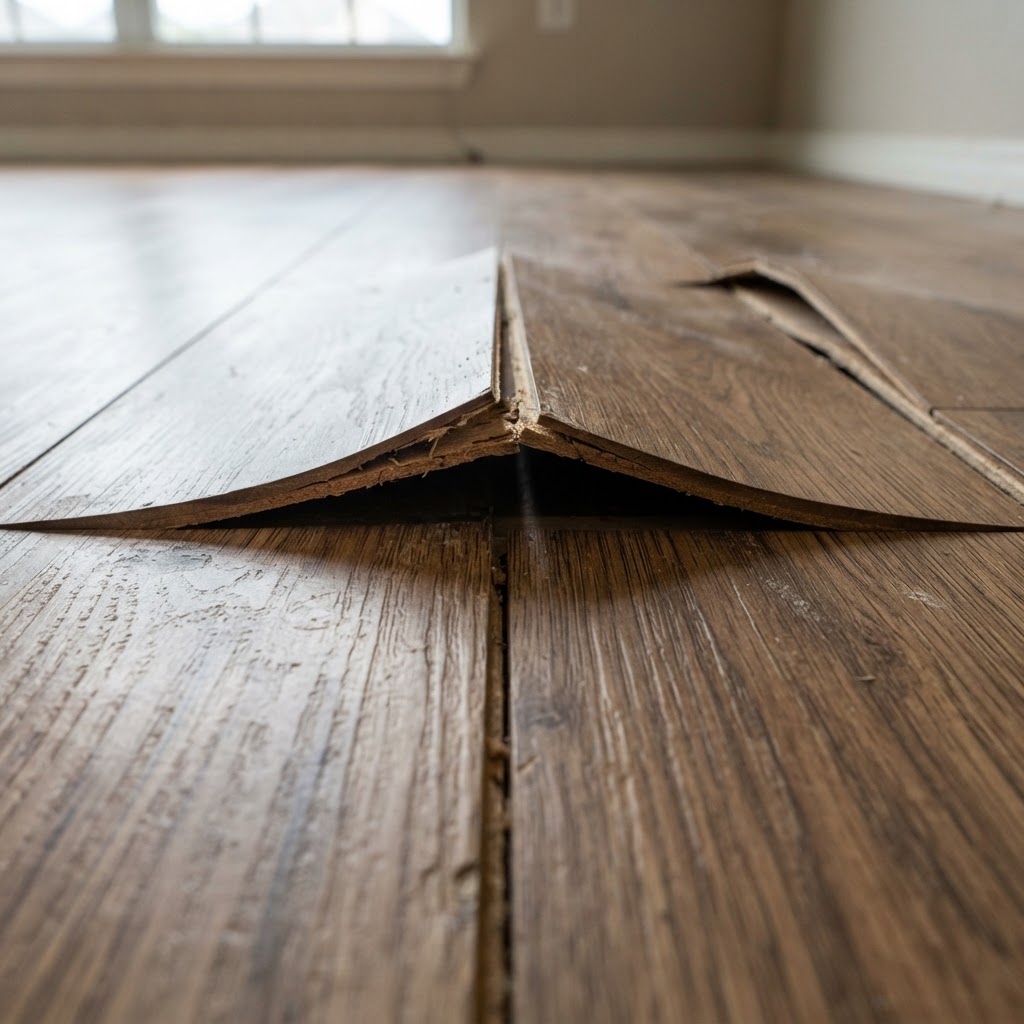
What Is Laminate Floor Peaking?
Laminate floor peaking — also called tenting or buckling — occurs when floating planks push against each other at joints and lift upward in a peaked ridge. It is a common installation defect that can appear weeks to months after installation, often triggered by seasonal temperature changes or the first high-humidity period following installation.
Unlike SPC, laminate has a wood-fiber HDF (High Density Fiberboard) core that is genuinely susceptible to moisture. When the core absorbs moisture, it swells not just dimensionally but also loses structural integrity. Peaking from moisture-damaged laminate is typically permanent — the swollen core does not recover.
Root Cause Analysis
Why Laminate Floors Fail
Laminate flooring's HDF (High Density Fiberboard) core is its fundamental vulnerability. Unlike SPC or vinyl, the wood-fiber core is genuinely susceptible to moisture — it swells irreversibly when wet and loses structural integrity. Combined with the compressive forces of thermal expansion, laminate fails when moisture or movement exceeds the system's capacity to absorb it.
Inadequate Expansion Gaps
Laminate requires expansion gaps at all fixed perimeters. When installers run flooring tight to walls or under door stops, the expanding floor has no room and buckles upward at joints — the classic peaking failure.
Moisture Infiltration into HDF Core
Even minor water exposure — pet accidents, appliance seeps, excessive mopping — causes the HDF core to swell irreversibly. The swelling creates lateral pressure that pushes planks upward and destroys locking joints.
Missing Transition Strips
T-moldings function as expansion breaks between rooms and flooring sections. Omitting them in long runs or at room divides concentrates expansion stress into a single area, causing peaking at the stress point.
Subfloor High Spots
Laminate installed over subfloor high spots bridges across the high point, creating fulcrum-like stress. Under foot traffic and thermal expansion, the floor peaks at or adjacent to the high spots.
Improper Cleaning with Excess Water
Laminate is not waterproof. Mopping with excess water or steam mops forces moisture into joints and the HDF core. Over time, this causes swelling, peaking, and joint deterioration — a maintenance-caused failure often excluded from warranty.
What Causes Laminate Floor Peaking?
Inadequate Expansion Gaps at Perimeters
The primary cause. Laminate requires expansion gaps at all fixed perimeters — walls, door frames, cabinets, islands, columns, and hearths. The specific gap size is manufacturer-specified, but typically ¼" per 25 linear feet. When installers run flooring tight to walls or under door stops without allowing proper clearance, the expanding floor buckles.
Moisture Infiltration into HDF Core
Laminate's HDF core is vulnerable to moisture. Even minor water exposure — from pet accidents, appliance seeps, or excessive mopping — can cause the core to swell irreversibly. The swelling creates lateral pressure that pushes planks upward at joints.
Missing Transition Strips
Transition strips (T-moldings) are not merely decorative — they function as expansion breaks between rooms or flooring sections. Omitting them in long runs or at room divides concentrates expansion stress into a single area.
Subfloor High Spots
Laminate installed over subfloor high spots bridges across the high point, creating fulcrum-like stress concentrations. Under foot traffic and thermal expansion, the floor peaks at or adjacent to high spots.
Symptoms to Look For
- Raised ridges across the floor surface, typically at plank joints
- Peaking most severe in the center of large rooms or long runs
- Creaking or movement when walking across peaked sections
- Visible separation of the peak from the subfloor when pressed
- Peaking appearing seasonally — worst in summer or high-humidity periods
What an Inspector Checks
When to Call an Inspector
A certified flooring inspector should be engaged when:
• Peaking affects more than a localized section of the floor
• The floor is under warranty and the installer is disputing the cause
• Moisture is suspected as a contributing factor
• The matter involves a landlord, HOA, or insurance dispute
• You need a written expert opinion for contractor accountability
Our Inspection Process
Frequently Asked Questions
Can peaking laminate be fixed without replacement?
If the cause is purely inadequate expansion gap and the locking mechanisms are undamaged, removing perimeter trim and creating proper clearance may allow the floor to relax. However, if moisture has compromised the HDF core or locking joints are broken, replacement is required.
Is laminate peaking always the installer's fault?
Not always. While inadequate expansion gaps are an installation error, peaking from moisture absorption may involve multiple parties — the installer (if waterproofing was not addressed), the property owner (if the leak was not reported), or a manufacturer (if the product has substandard moisture resistance). Inspection establishes which applies.
Related Flooring Issues
SPC / Rigid Core
SPC (Stone Plastic Composite) and rigid core flooring develops separating or open joints when thermal expansion forces exceed the locking mechanism's capacity — typically caused by inadequate expansion gaps or extreme heat exposure.
Learn moreVinyl / LVP
Vinyl floor buckling — where planks or sheets lift dramatically off the subfloor — is caused by thermal expansion without adequate room, moisture beneath the floor, or adhesive failure in glue-down systems.
Learn moreMoisture Diagnostics
Moisture beneath flooring — from concrete vapor emission, plumbing leaks, or groundwater — is the single most common cause of flooring failures. Professional ASTM-certified moisture testing establishes the source, magnitude, and impact.
Learn more