What Is Flooring Adhesive Failure?
Glue-down flooring systems depend entirely on the adhesive bond between the flooring material and the substrate. When that bond fails, the floor lifts, sounds hollow, or buckles. Adhesive failures are among the most technically complex flooring defects to diagnose because the failure can originate from multiple sources — and identifying the correct cause determines who is responsible.
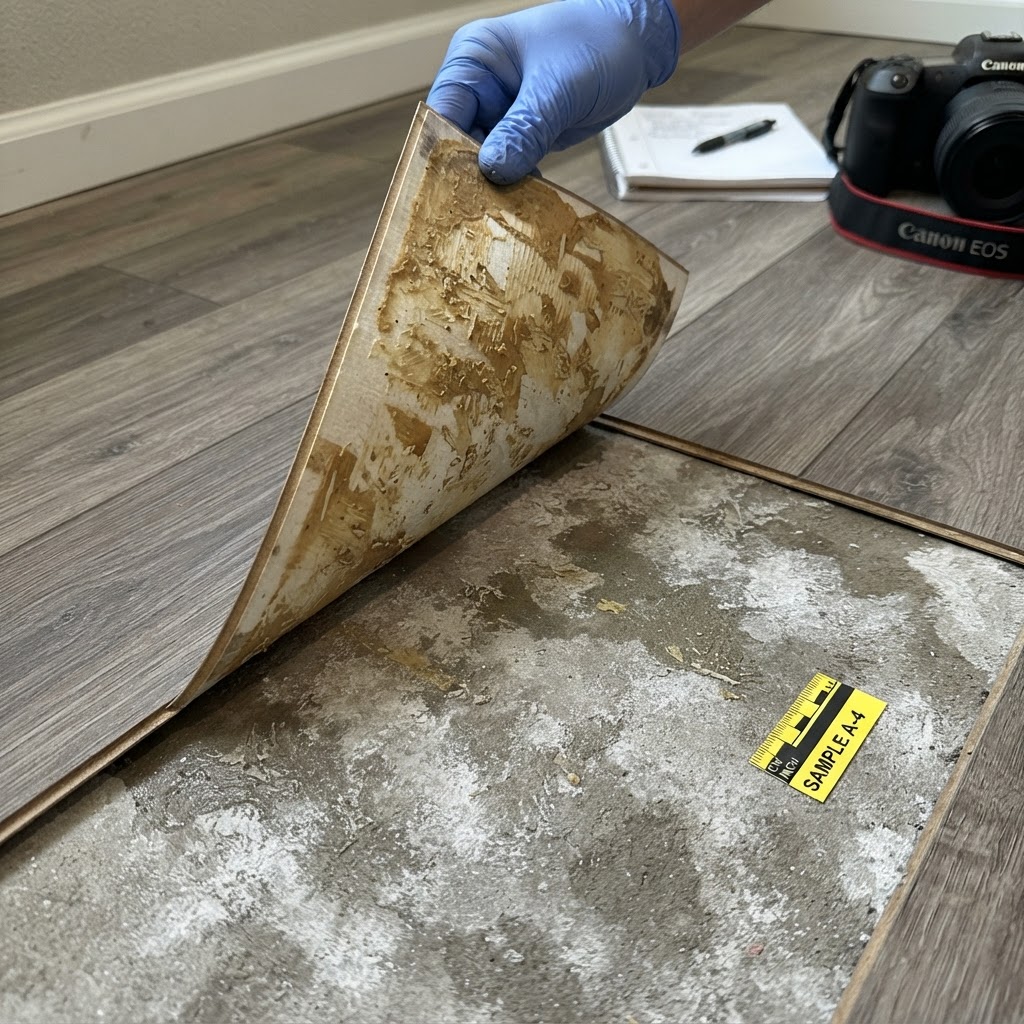
In Southern California, moisture-induced adhesive failure is the most common type. Concrete slab vapor emission dissolves water-soluble adhesives, migrates through the adhesive layer, and destroys the bond at the substrate interface. This failure pattern is frequently misidentified as a "bad adhesive" when the actual cause is a non-compliant moisture condition prior to installation.
What Causes Flooring Adhesive Failure?
Substrate Moisture Exceeding Adhesive Tolerance
Most adhesives specify a maximum slab moisture condition (per ASTM F2170 or F1869) above which they are not warranted. When concrete slab moisture vapor emission or relative humidity exceeds these thresholds, the adhesive either does not cure properly or loses its bond progressively. This is the most common cause of large-scale adhesive failure in Southern California.
Wrong Adhesive for the Application
Not all adhesives are compatible with all flooring products, substrate types, or installation conditions. Using a pressure-sensitive adhesive for a product requiring a hard-set adhesive, or using an interior adhesive in a wet or below-grade application, guarantees failure. Forensic review of the adhesive label and technical data sheet is a standard step in adhesive failure investigation.
Improper Trowel Notch Size or Application Method
Adhesive transfer to the flooring back is governed by the trowel notch geometry specified by the adhesive manufacturer. Oversized notches leave ridges too thick to flatten. Undersized notches leave insufficient adhesive for transfer. Either condition produces a non-compliant bond that will fail under use.
Contaminated or Unprepared Substrate
Dust, oil, curing compound, paint, or residual adhesive from previous installations prevents proper bonding. Substrates require mechanical preparation (shot blasting, grinding, or scarifying) to achieve the clean, porous surface that adhesives require for penetration and grip.
Open Time Exceeded
Adhesives have a working window between application and flooring installation. If the open time is exceeded — the adhesive has skinned over — the flooring cannot transfer properly. In warm Southern California conditions, open time can be significantly shorter than the adhesive technical data sheet states for standard temperature conditions.
Symptoms to Look For
- Hollow sounds when tapping or walking across glue-down flooring
- Edges of planks, tiles, or sheets lifting from the substrate
- Buckling or tenting in isolated or widespread areas
- Flooring movement underfoot in areas that were previously firm
- White powdery residue visible under lifted flooring (efflorescence from moisture)
- Adhesive that appears tacky, wet, or degraded rather than cured
What an Inspector Checks
When to Call an Inspector
Engage a certified inspector when:
• Large areas of glue-down flooring are lifting or sounding hollow
• The contractor and manufacturer are disputing the cause
• An insurance claim involves water-damaged adhesive flooring
• You need expert documentation for a warranty or legal claim
• A commercial installation has failed within the adhesive warranty period
Our Inspection Process
Frequently Asked Questions
Is adhesive failure always the installer's fault?
Not always. Adhesive failure from substrate moisture may be caused by the property owner's failure to disclose known moisture conditions, the general contractor's failure to test the slab before scheduling flooring, or a previous contractor's failure to install vapor mitigation. Forensic inspection identifies the chain of contributing factors.
Can adhesive failure be repaired in place?
Minor edge lifting can sometimes be re-bonded if the correct adhesive is used and the underlying cause is resolved. Widespread adhesive failure requires full removal and reinstallation after moisture mitigation. Re-bonding over a moisture-active slab without mitigation will fail again.
Related Flooring Issues
Vinyl / LVP
Vinyl floor buckling — where planks or sheets lift dramatically off the subfloor — is caused by thermal expansion without adequate room, moisture beneath the floor, or adhesive failure in glue-down systems.
Learn moreTile & Stone
Hollow tile sounds — a drum-like resonance when tapping — indicate that the tile has lost bond with the substrate below. This signals installation deficiency, moisture-induced debonding, or structural movement.
Learn moreMoisture Diagnostics
Moisture beneath flooring — from concrete vapor emission, plumbing leaks, or groundwater — is the single most common cause of flooring failures. Professional ASTM-certified moisture testing establishes the source, magnitude, and impact.
Learn more