What Is Concrete Slab Moisture & Vapor Emission?
Concrete slabs are porous. Moisture from soil, groundwater, and residual curing water migrates continuously through concrete slabs as vapor. When flooring is installed without proper moisture assessment, this vapor is trapped beneath the flooring system — where it destroys adhesive bonds, causes hardwood to cup and swell, delaminates engineered veneer layers, and supports mold growth.
In Southern California, concrete slab moisture is elevated by three primary conditions: older post-WWII residential construction without vapor retarders, coastal and low-lying areas with elevated water tables, and expansive clay soils that hold and release moisture seasonally. The result is a regional flooring failure epidemic that could be largely prevented by proper pre-installation testing.
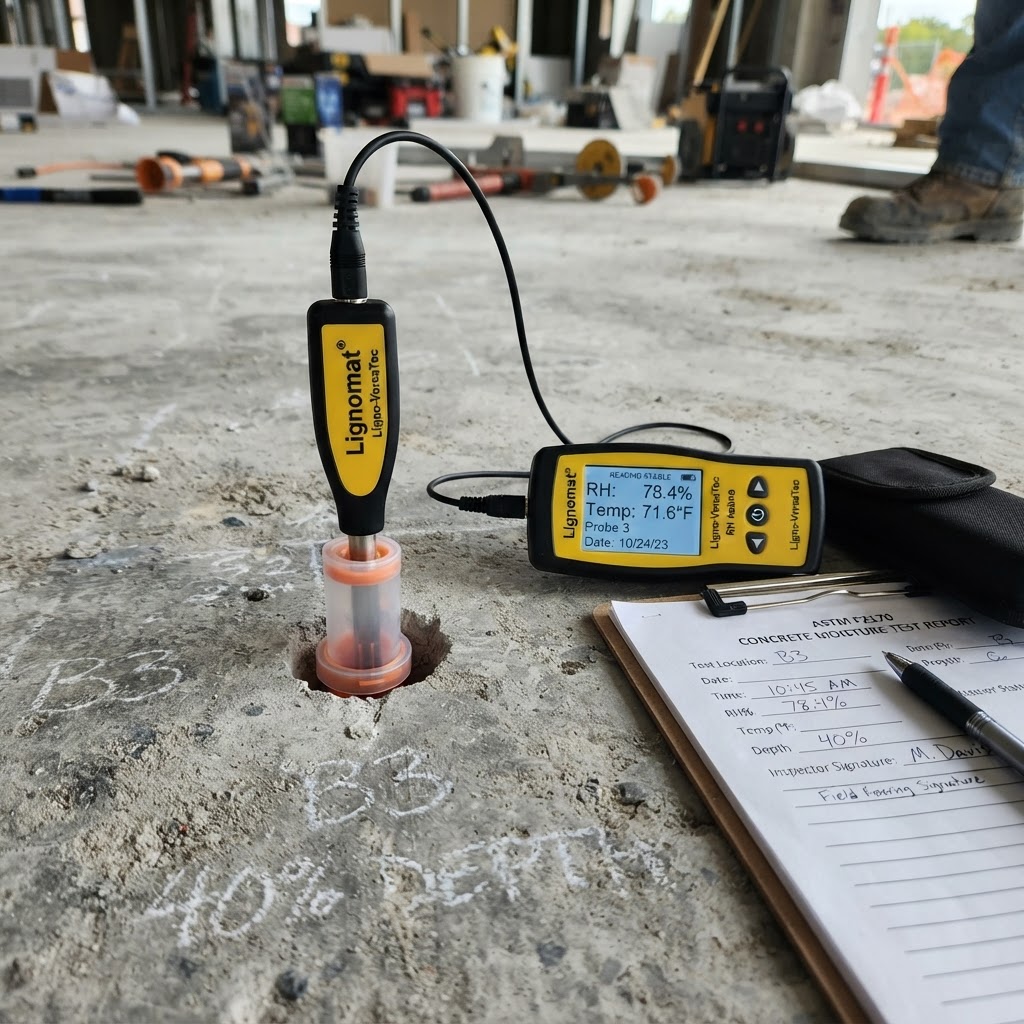
ASTM F2170 — the Standard Test Method for Determining Relative Humidity in Concrete Floor Slabs Using in situ Probes — is the most reliable method for assessing the true moisture condition of a concrete slab. It measures RH at 40% slab depth, which reflects the moisture that flooring will actually be exposed to. Most major flooring manufacturers specify ASTM F2170 testing as a warranty requirement.
What Causes Concrete Slab Moisture & Vapor Emission?
No Vapor Retarder or Non-Compliant Vapor Retarder
A vapor retarder (commonly called a vapor barrier) placed beneath the slab during construction prevents ground moisture from migrating upward. Many post-WWII Southern California slabs were constructed without vapor retarders, or with materials that have since degraded. Without a functional vapor retarder, moisture migration through the slab is continuous and unimpeded.
Elevated Groundwater and Coastal Water Tables
Properties in coastal areas, near drainage channels, or in low-lying neighborhoods have water tables closer to the surface. Hydrostatic pressure forces moisture through the slab — sometimes at levels that overwhelm even properly installed mitigation systems.
Slab Not Fully Cured at Time of Installation
Fresh concrete releases significant moisture during the curing process. Industry guidelines require concrete to be sufficiently cured before flooring installation — typically measured by achieving ASTM F2170 RH below the flooring manufacturer's threshold. Accelerated construction schedules frequently lead to flooring installation over slabs that are still releasing curing moisture.
Landscaping and Irrigation
Irrigation systems adjacent to slabs, particularly on the west and south sides of buildings, can saturate the soil surrounding the foundation and elevate slab moisture conditions. This is a common and frequently overlooked moisture source in Southern California residential properties.
Symptoms to Look For
- Hardwood or engineered wood cupping or warping without an obvious water event
- Glue-down vinyl or LVP debonding from the substrate
- White crystalline deposits (efflorescence) visible at concrete cracks or through flooring
- Musty odor beneath or around the flooring
- Mold growth at baseboards or in subfloor cavities
- Flooring failures that recur after repair if the slab is not treated
What an Inspector Checks
When to Call an Inspector
ASTM F2170 slab moisture testing is required when:
• Any flooring over concrete is failing without an obvious water event cause
• New flooring installation is planned over concrete (pre-installation testing)
• A warranty claim is being evaluated for moisture-related failure
• An insurance claim involves flooring over a concrete slab
• A legal dispute involves flooring installed over concrete
Our Inspection Process
Frequently Asked Questions
What is a passing moisture level for concrete per ASTM F2170?
The acceptable threshold varies by flooring product. Most hardwood manufacturers require slab RH below 75–80%. Many vinyl and LVP manufacturers allow higher levels but specify a maximum. The applicable standard is always the flooring manufacturer's installation specification — not a universal number. Exceeding the manufacturer's threshold at installation is a documented installation defect.
Can high concrete moisture be fixed?
Yes. Moisture mitigation options include topical vapor-barrier coatings, moisture-control underlayments, and surface-applied moisture-reduction treatments. The correct mitigation method depends on the RH level measured, the flooring product to be installed, and the source of the moisture. In severe cases (RH above 95%), mechanical dehumidification or slab sealing may be required before any coating system.
Does a new concrete slab need moisture testing?
Yes. New slabs release significant curing moisture and should be tested per ASTM F2170 before any flooring installation. Industry guidelines require concrete to reach the flooring manufacturer's specified RH threshold before installation begins. Testing is not optional — it is a warranty requirement for most flooring products.
Related Flooring Issues
Hardwood Flooring
Cupping occurs when the edges of hardwood planks rise higher than the center, creating a concave wave across the floor surface. It is almost always a moisture-driven failure.
Learn moreMoisture Diagnostics
Moisture beneath flooring — from concrete vapor emission, plumbing leaks, or groundwater — is the single most common cause of flooring failures. Professional ASTM-certified moisture testing establishes the source, magnitude, and impact.
Learn moreMoisture Diagnostics
Adhesive failure in glue-down flooring — vinyl, LVP, hardwood, or tile — causes debonding, hollow sounds, and buckling. The cause is almost always substrate moisture, wrong adhesive selection, or improper application.
Learn more