What Is Vinyl Floor Buckling?
Vinyl plank flooring, including LVP (Luxury Vinyl Plank), WPC (Wood Plastic Composite), and traditional sheet vinyl, is frequently marketed as dimensionally stable and water-resistant. While these products have improved significantly in recent years, buckling and lifting failures remain among the most common flooring complaints we investigate in Southern California.
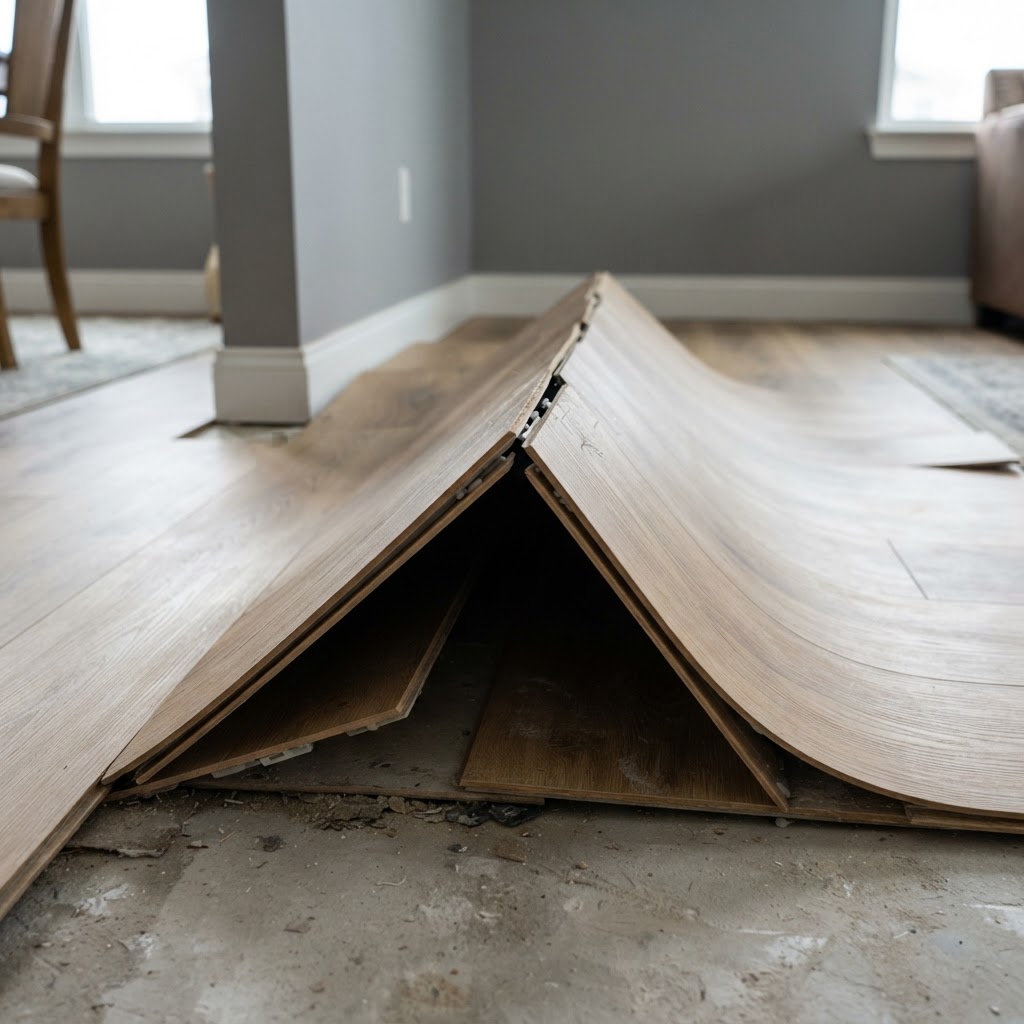
Buckling is distinct from joint separation — it involves the flooring lifting dramatically off the substrate in a tented or heaved configuration. In severe cases, buckled vinyl creates a significant tripping hazard and can damage the locking mechanisms beyond repair.
What Causes Vinyl Floor Buckling?
Thermal Expansion Without Expansion Gap
Floating vinyl floors expand with heat. All manufacturers require expansion gaps at walls, transitions, columns, and any fixed obstruction. When gaps are absent or undersized, expanding flooring has no relief point and buckles upward. In Southern California, afternoon sun through west-facing glass can raise floor surface temperatures significantly above air temperature.
Adhesive Failure in Glue-Down Systems
Glue-down sheet vinyl and glue-down LVP rely on adhesive bond to remain flat. When adhesive fails — from improper spread rate, wrong adhesive selection, subfloor moisture, or porosity issues — sections lift and buckle. Adhesive failure beneath vinyl is not always visible until the floor is lifted.
Excessive Subfloor Moisture
While SPC and LVP are waterproof on the surface, moisture beneath the flooring can destroy adhesive bonds, warp wood-based underlayment layers, or structurally damage the subfloor — all of which cause the surface flooring to buckle. ASTM moisture testing of concrete substrates prior to installation is the standard prevention method.
Subfloor Irregularity
Vinyl is not a self-leveling product. Installed over high spots in the subfloor, individual planks may seesaw and eventually fail at locking joints. Installed over low spots, the floor spans voids that concentrate stress under foot traffic.
Acclimation Failure
Some vinyl products require acclimation to the installation environment. Installing flooring that has been stored in a hot truck or cold warehouse without allowing it to normalize to room temperature can cause initial expansion or contraction that stresses the installation.
Symptoms to Look For
- Sections of flooring lifting off the subfloor in a tent-like profile
- Dramatic movement underfoot in affected areas
- Audible cracking or snapping as the floor moves
- Visible separation between the floor and baseboards
- Buckling concentrated along one wall or in the center of a large room
- Sheet vinyl with raised ridges, particularly at seams or near perimeters
What an Inspector Checks
When to Call an Inspector
Call a certified flooring inspector when:
• Buckling covers more than a small localized area
• The floor is newly installed and failing within the warranty period
• The contractor denies responsibility and disputes the cause
• An insurance claim is involved (appliance failure, flood event)
• You need documentation for a manufacturer warranty dispute
Our Inspection Process
Frequently Asked Questions
Will buckled vinyl flooring go back down on its own?
Heat-related buckling may partially recover when temperatures cool, but the underlying installation deficiency remains. Each thermal cycle causes progressive stress on the locking system. Repeated buckling eventually destroys the locking mechanism, requiring full replacement.
Is buckled vinyl covered by the manufacturer warranty?
Manufacturer warranties typically cover product defects but specifically exclude installation errors, including inadequate expansion gaps. A certified independent inspection is essential to determine whether the failure is a product defect (warranty-eligible) or an installation error (contractor liability).
Can I fix buckled vinyl myself?
Attempting DIY repair without identifying the cause typically results in the same failure recurring. The cause must be identified — and corrected — before any reinstallation. An inspection report also provides documentation needed for warranty or insurance claims.
Related Flooring Issues
SPC / Rigid Core
SPC (Stone Plastic Composite) and rigid core flooring develops separating or open joints when thermal expansion forces exceed the locking mechanism's capacity — typically caused by inadequate expansion gaps or extreme heat exposure.
Learn moreLaminate
Laminate floor peaking occurs when floating planks buckle upward at joints due to compressive forces from thermal expansion or moisture absorption — almost always related to inadequate expansion clearances.
Learn moreMoisture Diagnostics
Moisture beneath flooring — from concrete vapor emission, plumbing leaks, or groundwater — is the single most common cause of flooring failures. Professional ASTM-certified moisture testing establishes the source, magnitude, and impact.
Learn more